The New Berlin Airport Finally Opens
After nearly 15 years of construction delays, the long-anticipated Berlin Brandenburg Airport has finally started operations. Named after German politician Willy Brandt, the airport lies about 27 km (16.7 miles) south of Berlin’s city center, in the state of Brandenburg.
Work on the new airport began back in 2006, with an initial completion target set for 2011. However, repeated setbacks postponed the inauguration until October 31, 2020. The project was intended to consolidate Berlin’s air traffic by replacing Schönefeld, Tegel, and Tempelhof airports. Tempelhof was shut down in 2008, while Tegel saw its final flight on November 8, 2020. Schönefeld was supposed to remain active until 2025 as part of BER, but it has already been permanently closed. Currently, the airport features two terminals and two runways, with future plans for additional terminals and a satellite building.
Berlin Brandenburg is designed to handle 35–40 million travelers annually, aiming to become one of Europe’s busiest hubs. By 2022, it had already climbed to the third busiest airport in Germany and one of the top 15 in Europe. Passenger traffic doubled from 9.95 million in 2021 to 19.85 million in 2022, showing rapid growth.
Transportation Options
Passengers at BER can choose among several transfer options: public transit, buses, airport taxis, private transfers, or rental cars, ensuring smooth connections to Berlin and beyond.
Berlin Brandenburg Airport Information
- Airport Name: Berlin Brandenburg Airport (Willy Brandt)
- IATA Code: BER
- ICAO Code: EDDB
- Location: Schönefeld, Germany
- Time Zone: Central European Time (GMT+1)
- Map: View on Google Maps
Airport Layout
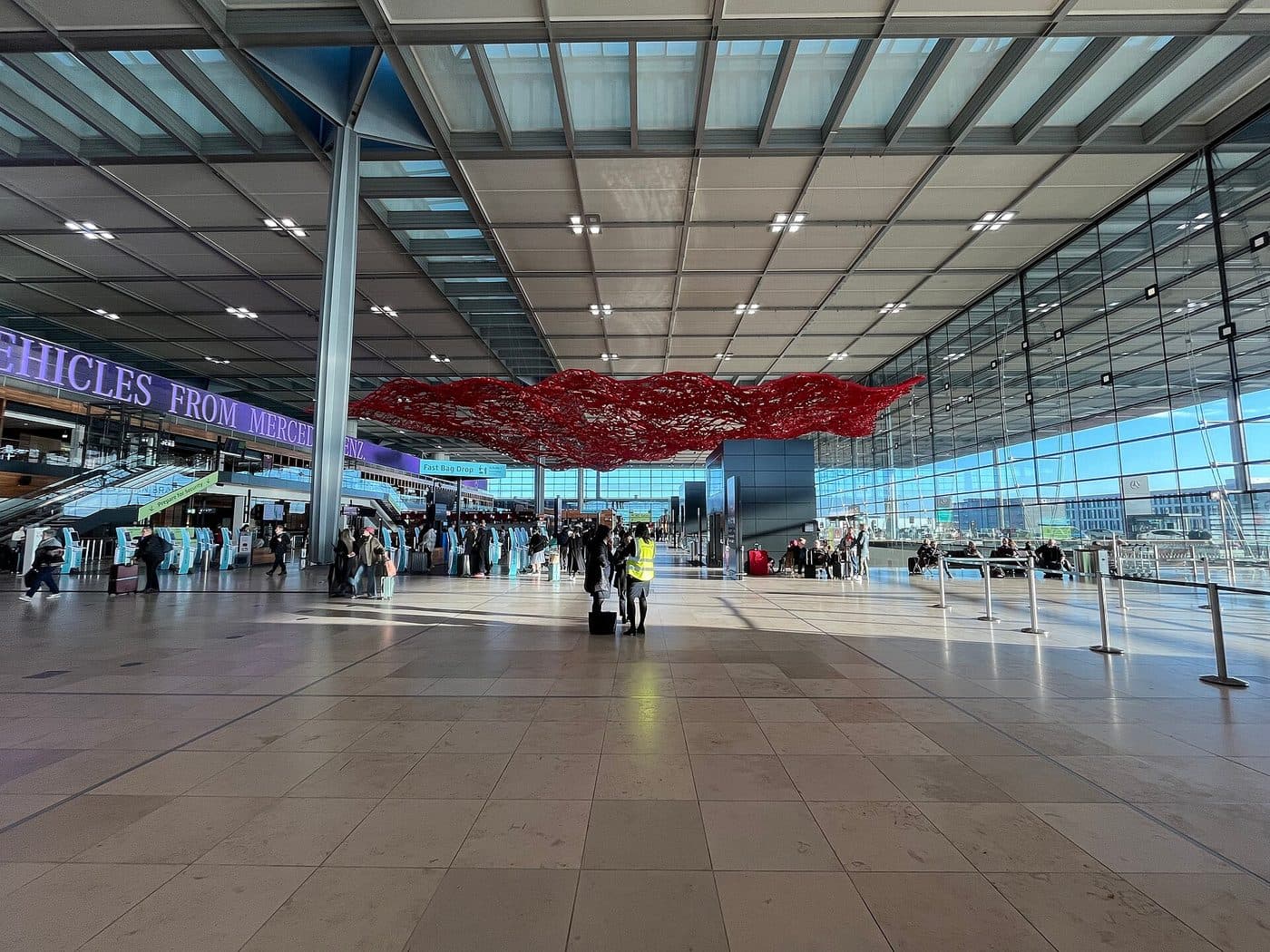
Berlin Brandenburg Airport currently has two terminals. The main Terminal 1, shaped like a U, manages most of the airport’s traffic and hosts a wide range of passenger services, including one of the two on-site airport hotels. Right next to it is Terminal 2, which is smaller but located within walking distance of T1.